
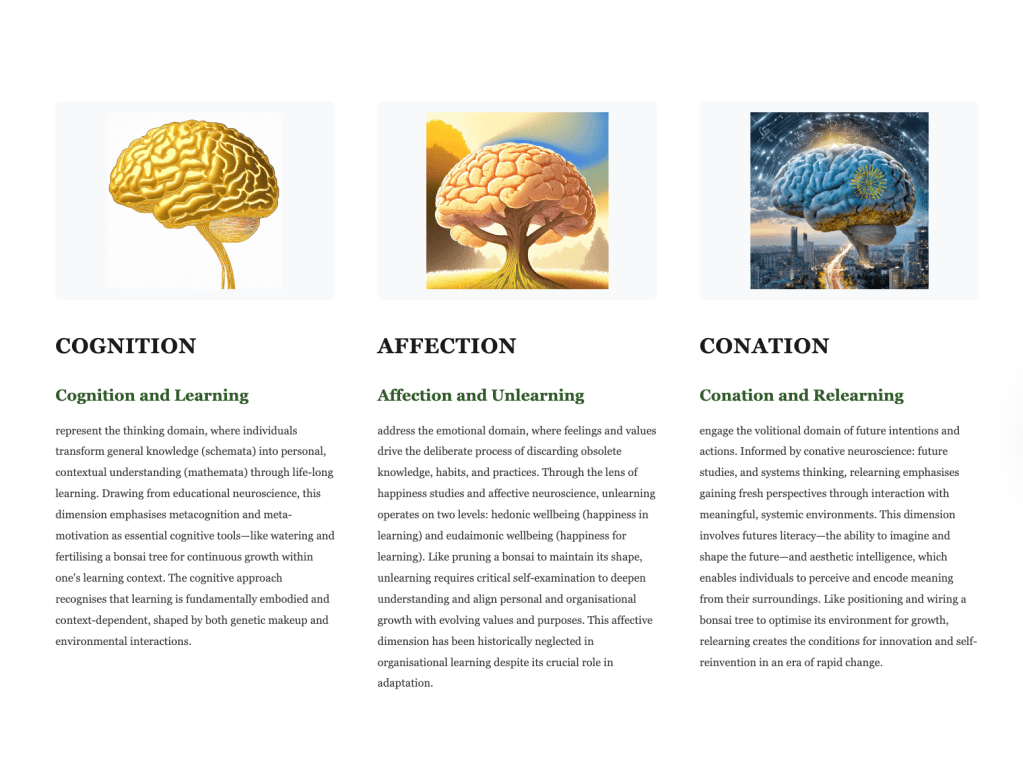
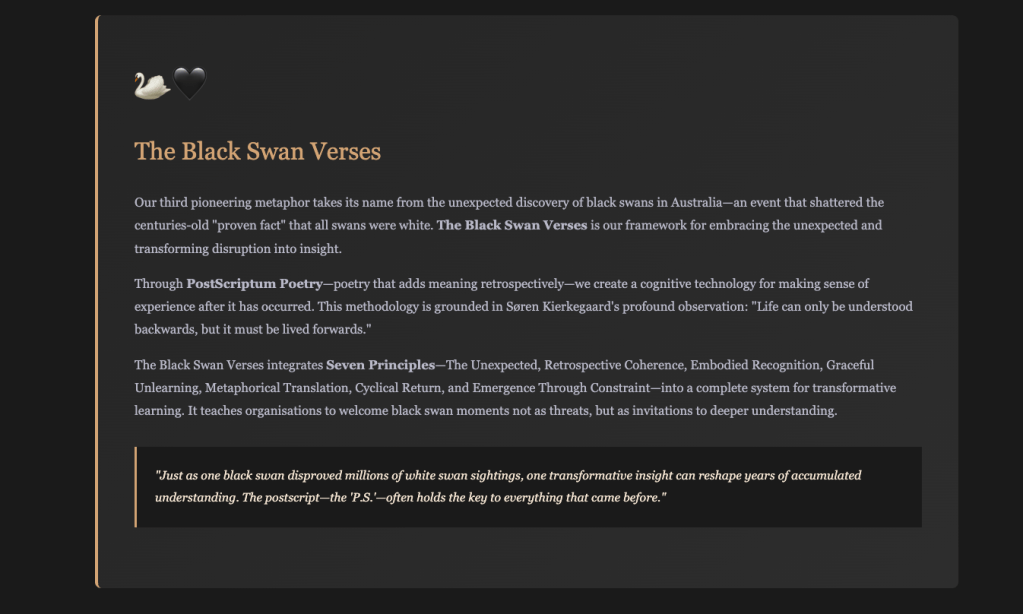
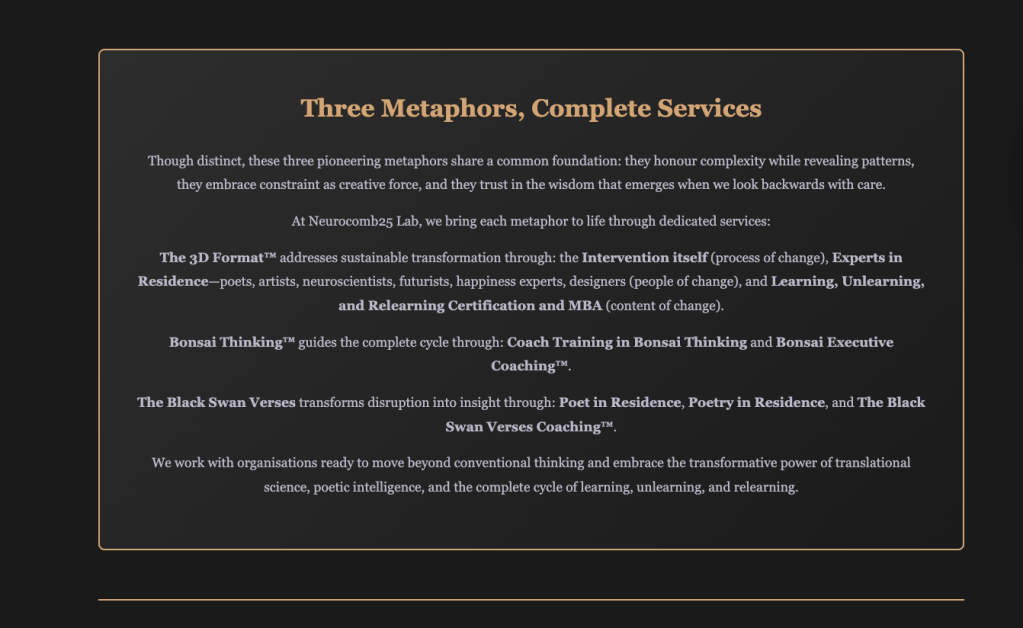

Let’s learn, unlearn, and relearn!
Meet our Director and Chief Neuroscientist

Aleksandra Halchenko
When she says innovation – she means it!
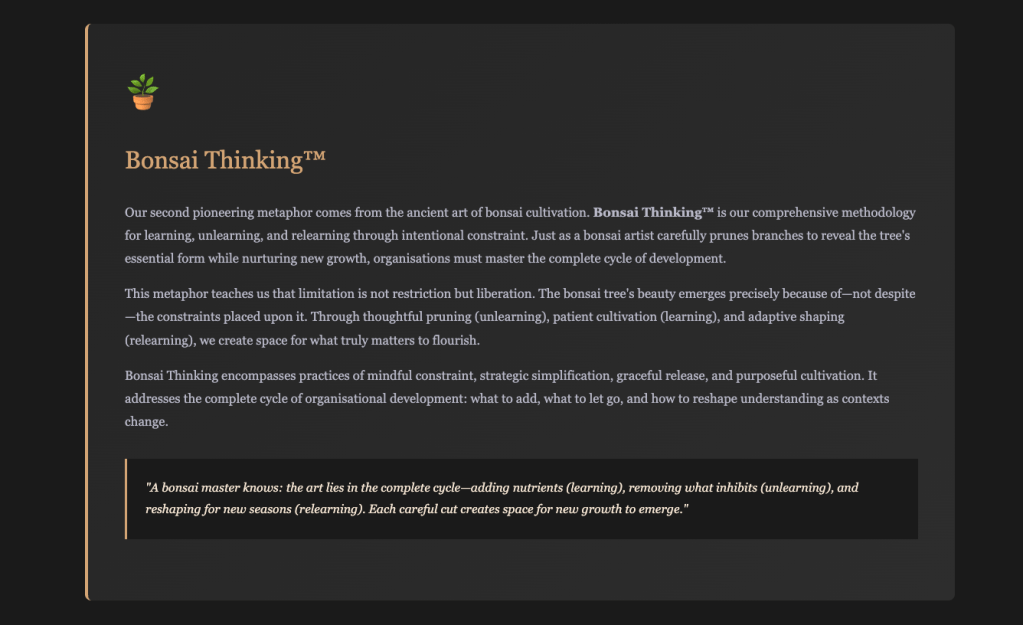
Aleksandra Halchenko is the founder and chief educational neuroscientist at Neurocomb25 Lab, where she has pioneered a new field of Learning, Unlearning, and Relearning with two groundbreaking methodologies that transform how leaders and organisations navigate complexity: Bonsai Thinking™ – The Science of Learning, Unlearning, and Relearning, the most cutting-edge framework for advanced metacognition and transformation, and The Black Swan Verses™ – PostScriptum Poetry as Cognitive Technology for Learning, Unlearning, and Relearning.
As the world’s first learning, unlearning, and relearning scientist and the inventor of PostScriptum Poetry™ as a cognitive technology, Aleksandra has created entirely new territory at the intersection of neuroscience, poetic practice, and metacognitive architecture. Her work addresses what futurist Alvin Toffler identified as the defining literacy of our era: the capacity to learn what is needed, unlearn what no longer serves, and relearn with the agility that complex environments demand.
Through Bonsai Executive Coaching™ and The Black Swan Verses Coaching™, Aleksandra works with C-suite executives, HNWIs, and modern professionals, bringing more than 12 years of coaching and leadership development experience to help clients access the breakthrough insights that remain invisible through conventional analytical approaches. Her coaching integrates cognitive neuroscience for learning, affective neuroscience for unlearning, and conative neuroscience for relearning, cultivating Emotional Intelligence (EQ) for learning, Spiritual Intelligence (SQ) for graceful unlearning, and Aesthetic Intelligence (AQ) for relearning—advancing both innovation and human flourishing in organisations.
The Black Swan Verses™ emerged from Aleksandra’s recognition that the most profound insights never arrive during experience itself, but retrospectively—in the reflection that follows. PostScriptum Poetry™, with its unique structure of poem body exploring lived experience followed by the P.S. (postscript) delivering retrospective insight, mirrors the actual architecture of breakthrough learning. Like the discovery of black swans in 1697 that shattered the certainty “all swans were white,” this methodology challenges the invisible assumptions executives and organisations mistake for immutable fact. It creates cognitive zero—a position without value from which entirely new patterns can emerge, much as the invention of zero revolutionised mathematics by creating space where none existed before.
Her pioneering work in conative science—particularly the science of relearning—includes novel research into neuroaesthetics and environmental affordances for learning. Based on these findings, Aleksandra advises NGOs, governments, and hospitality & real estate companies on creating meaningful environments that optimise learning and encourage innovation. She has held educational leadership roles, and worked in prominent institutions in the Middle East, an experience that instilled a deep appreciation for cross-cultural perspective and led her to study Middle Eastern Studies at the University of Oxford.
Aleksandra holds a degree in Educational Neuroscience from the University of London and is a professional futurist in education, qualified teacher in the UK, Cambridge University Press accredited teacher trainer, ICF-certified coach, and Happiness Studies graduate. She is a published poetess and the inventor of the “Black Swan Verses – PostScriptum Poetry” genre, recognised as a revolutionary contribution to both literary form and cognitive technology.
Currently, Aleksandra holds a JPB Fellowship from Harvard University’s T.H. Chan School of Public Health, where she contributes her expertise in learning, unlearning, and relearning to support the rebuilding of Ukraine, demonstrating how advanced metacognition can address challenges at the scale of societal transformation.
Her work with children, executives, and organisations shares a common thread: preserving and cultivating the rare capacity to see what others cannot see, to question what others accept as given, to create cognitive zero when others add complexity to existing patterns. In a world optimising for conformity and efficiency, Aleksandra teaches the revolutionary skill of staying rare.
The black swan was always there. She teaches you to see it.
“It is really the time for a new generation of creative scientists and “scientific artists” to unite and bring about change worldwide. The first step towards initiating change is to establish a dialogue between science and art, research and practice”
Aleksandra Halchenko

”Real Education starts from effective affordances! And it is not only about learning, it is all about unlearning and relearning!”
Aleksandra Halchenko
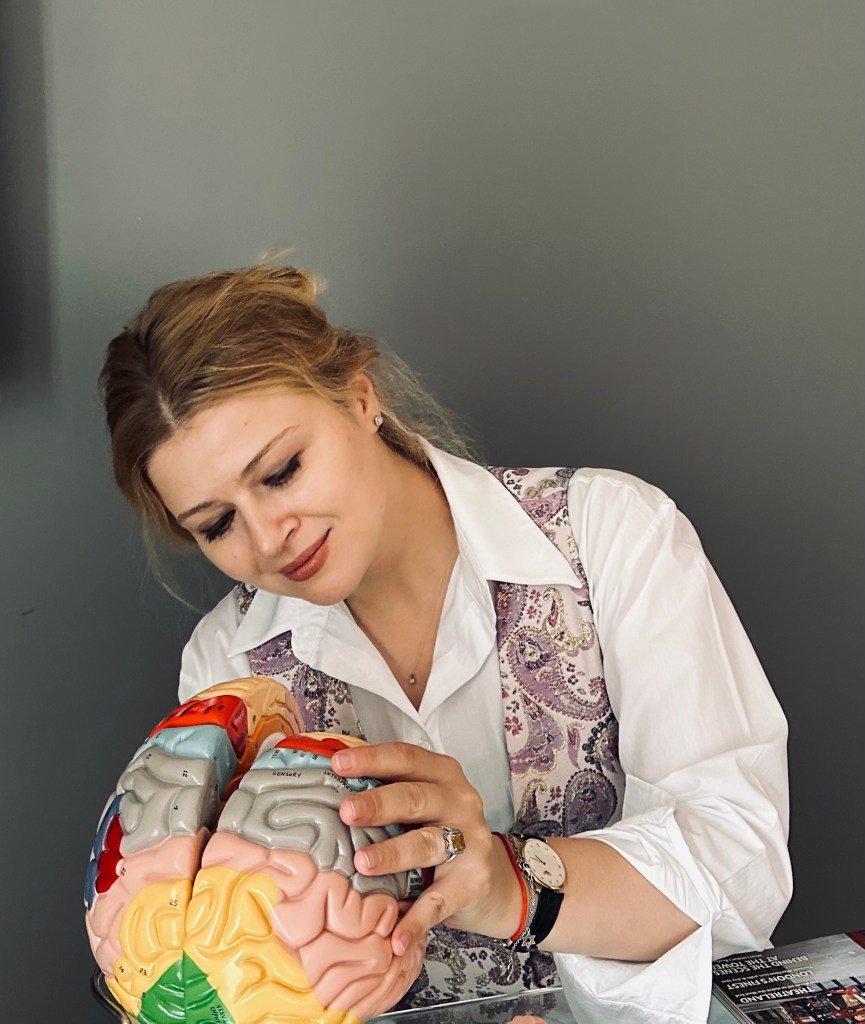
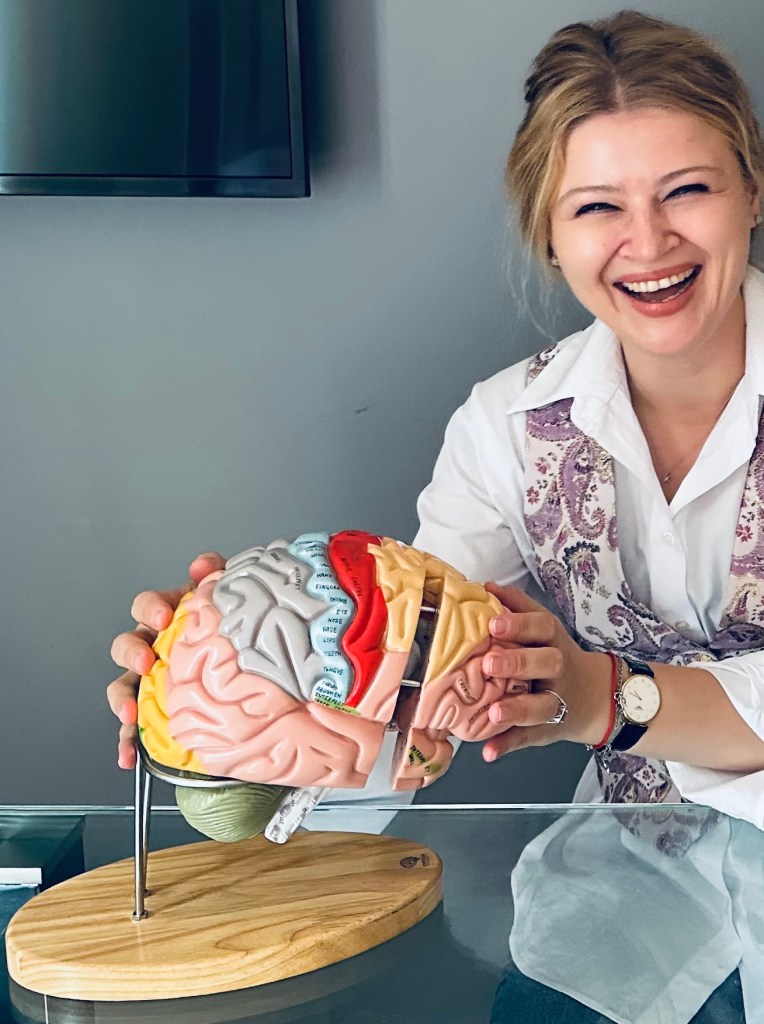
“Integrated approach to neuroscience helps us get a unified view of reality and enhances our chances to bring neuroscience to life.”
Aleksandra Halchenko
Our Approach
Our specialists are young researchers and practitioners in Cognitive, Affective, and Conative Neuroscience, who look at education not just through the eyes of an adult- when we zoom out to see the ‘big picture’, but also through the eyes of a child -by zooming in to be fully present.
The people we embed in your organisations are experts capable of sharing their research expertise in a way that improves the quality of education and brings a long-lasting change. Our cognitive, affective, and conative neuroscience lens enables us to offer research-based solutions to the educational issues of 25 years to come. We successfully bring those disciplines together through the science of learning, unlearning, and relearning to reform education systems for the age of super complexity.
 Neurocomb25®